
The 15th International Conference on Air Quality – Science and Application will be organized by Charles University and will take place in Prague, Czech Republic, in June, 1-5, 2026. We invite researchers, scientists, and experts in the field of air quality to join us in sharing the latest advancements, research findings and new applications in this area and related aspects.
Organized by

Conference Highlights
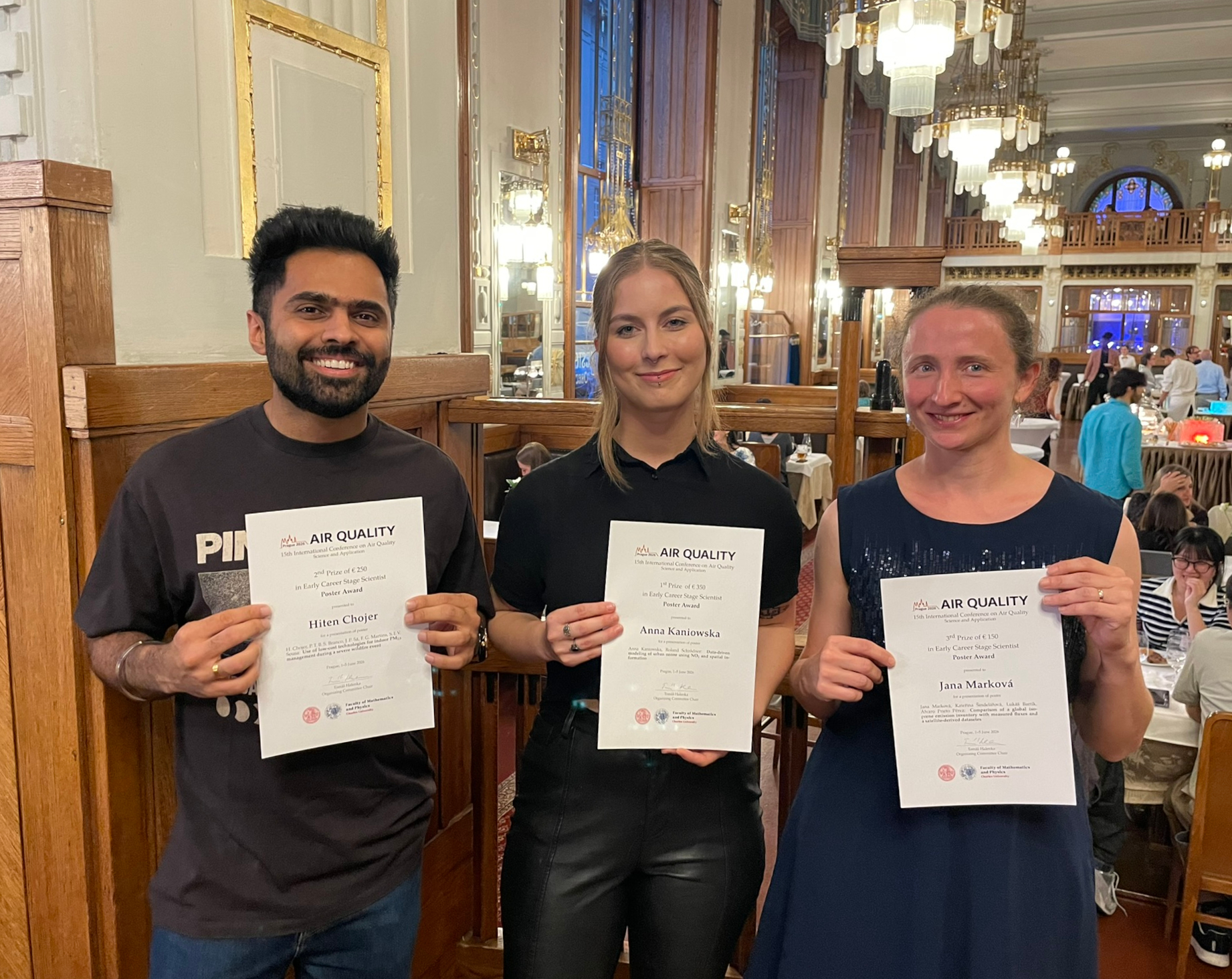
Poster Awards
- First place: Anna Kaniowska for the presentation A. Kaniowska, R. Schrödner: Data-driven modeling of urban ozone using NO2 and spatial information
- Second place: Hiten Chojer for the presentation H. Chojer, P. T. B. S. Branco, J. P. Sá, F. G. Martins, S. I. V. Sousa: Use of low-cost technologies for indoor PM2.5 management during a severe wildfire event
- Third place: Jana Marková for the presentation J. Marková, K. Šindelářová, L. Bartík, Á. P. Pérez: Comparison of a global isoprene emission inventory with measured fluxes and a satellite-derived datasetes
Call for papers
The 15th International Conference on Air Quality, organized by the Charles University, will be held from June 1 to June 5, 2026, in the historical, but vibrant city of Prague, Czech Republic. We invite researchers, scientists, and experts in the field of air quality to join us in sharing the latest advancements and research findings in relevant Main Themes of the Conference as well as Special Sessions identified.
Abstract submissions
Abstract submission is now closed.
Authors will receive information on acceptance after review of the abstracts by Members of International Science and Advisory Board around mid-March.
We plan to collect extended abstracts prior to the Conference to prepare an electronic proceedings volume, to be published shortly after the event. Options for formal publication and potential indexing are currently being explored and will be confirmed in due course. Building on the most successful sessions, we also anticipate discussing thematic special issues in relevant peer-reviewed journals, offering selected contributions the opportunity for further development and publication.
Conference Themes:
- Development, application and evaluation of air quality related models for local to global scales: Advances in modeling techniques for better understanding and forecasting of air quality.
- Air quality monitoring and earth observations: Advances in measurement techniques and in combining satellite observations with measurements from ground-based instruments and models.
- Air Pollution Sources and Emissions: Identifying, quantifying, and mitigating sources of air pollution of emerging concern, including industrial, transport, and natural sources.
- Health and Environmental Impacts: Assessing the impact of air pollution on human health, ecosystems, and the environment, as well as strategies for mitigation, including exposure evaluation.
- Air Quality Policies and Regulations: Discussing international and local policies, regulations, and best practices for air quality management and improvement. New challenges for the policy-regulatory framework: fine and ultrafine particles; allergenic pollen; exposure thresholds.
- Climate Change and Air Quality Interactions: Exploring the relationship between air quality and climate change, as well as strategies for tackling both challenges simultaneously. Short lived climate pollutant effects. The impacts of wildfires on Climate and Air Quality.
- Urban air quality: air quality challenges (modelling, monitoring, assessment) in urban environments. The aspect of spatial and temporal scale; green spaces and their AQ implications; current and future mobility methods and technologies and their impact on the urban environment.
- Air quality information services: mobile apps, context aware web-based services, gamification-oriented methods and tools, good practices in service design, project & city-oriented examples.
Special sessions:
-
Pan-Eurasian EXperiment (PEEX) contribution on air quality in Mega and Gigacities
-
Transport emissions and policies
-
Machine learning /AI supported air quality monitoring and modelling
-
Emissions from agriculture, e.g. livestock farming, fertilization, precission agriculture. Their impacts on air quality and climate.
-
Science and policy for clean air and carbon neutral cities, revision of the Ambient Air Quality Directive
-
From Smart Cities to Citizen Scientists: Unveiling the Power of Crowdsourcing Sensor Networks in Air Quality Monitoring
-
Nature-based solutions for air pollution reduction
International Science and Advisory Board
Dr Peter Suppan, Chair, Karlsruhe Institute of Technology, Germany
Professor Ranjeet S Sokhi (Honorary Chair), University of Hertfordshire, UK
Professor Nicolas Moussiopoulos, Aristotle University Thessaloniki, Greece
Professor Alexander Baklanov, University of Copenhagen, Denmark
Dr Camilla Geels, Aarhus University, Denmark
Dr Sandro Finardi, ARIANET, Italy
Dr Gufran Beig, Indian Institute of Science (IISc), India
Professor Judy Chow, Desert Research Institute, USA
Dr Ari Karppinen, Finnish Met Institute, Finland
Professor Roberto San Jose, Technical University of Madrid, Spain
Assoc. Professor Riccardo Buccolieri, University of Salento, Italy
Professor Selahattin Incecik, Technical University of Istanbul, Turkey
Professor Kostas Karatzas, Aristotle University Thessaloniki, Greece
Assoc. Professor Tomáš Halenka, Charles University, Prague, Czech Republic
Dr. Tom V Kokkonen, University of Helsinki, Finland
Prof. Tijian Wang, Nanjing University, China
Prof. Li Li, Shanghai University, China
Dr. Jana Moldanova, IVL, Swedish Environmental Research Institute, Sweden
Professor Isabel Coll, University of Paris Est Creteil, France
Dr. Mihaela Mircea, ENEA, Rome, Italy
Prof. Ana Isabel Miranda, University of Aveiro, Portugal
Prof. Maria de Fatima Andrade, University of Sao Paulo, Brasil
Prof. Jiacan Yuan, University of Shangai, China
Local organizing team
Tomáš Halenka
- for inquiries please contact via
Michal Belda
Helena Nyklová
Tung Anh Vu
Pravoslava Havelková
Natália Machado Crespo
Jelena Radović
Hynek Řezníček
Francesco Rizziero
Harshwardhan Jadhav
Manas Pant
Aditia Nalam
Programme
On-site registration: Monday 1 June 15:30-18:30
The latest version of the full conference programme is available for download here: AQ2026-Program-full-v5.pdf
A block schedule of thematic sessions and social events is available for download here: AQ2026-Program-sections.pdf
Presenters are kindly requested to upload their presentation files no later than 20:00 (8:00 PM) on the day preceding their scheduled presentation using the upload form.
Conference abstracts are available here: Abstracts
A list of posters is available for download here: Poster list
Registration
Registration is closed.
Registration Fees
| Category | Amount (by 25 May 2026) |
|---|---|
| Regular | 545 € |
| Student / LIC * | 430 € |
| Scientific Committee | 430 € |
| Accompanying Person | 210 € |
| Exhibitor | 1 500 € |
* LIC — Low-Income Countries, as classified by the World Bank. Participants from LIC are eligible for the reduced registration fee.
The conference fee includes the full in-person attendance in the conference sessions including lunch and coffee (Tuesday-Friday, only for conference attendees) and the networking programme including welcome drink (Monday), ice breaker, and conference dinner.
Exhibitor fee includes a table with chairs on the corridor/in the room (to be decided)
next to the conference halls, electrical outlet, Wi-Fi connection, one full standard
conference registration package (one person for full attendance of the
Conference Programme, including networking events and meals).
The recipient of the registration fee is:
Univerzita Karlova, Matematicko-fyzikální fakulta
Ke Karlovu 3, 121 16 Praha 2
IČ: 00216208, DIČ: CZ00216208
Limited resources might be available to support ECS from LMIC to participate in the Conference by means of the Conference fee waivers. You may apply for that via e-mail sent to Please provide a short CV and motivation, abstract submitted is expected.
Cancellation Policy
- Cancellations received on or before 10 May 2026 are eligible for a full refund, minus a €50 administrative handling fee.
- Cancellations received after 10 May 2026 are not eligible for a refund.
- No refunds will be issued for no-shows.
- Denial of a visa application to enter the Czech Republic does not entitle the participant to a refund.
Insurance and Liability
The conference organisers accept no liability for personal injuries, or for loss of or damage to property belonging to participants or their accompanying persons, whether occurring during or as a result of the conference. The registration fee does not include insurance of any kind. Participants are responsible for ensuring they hold adequate personal travel and health insurance for the duration of their stay.
The organisers accept no responsibility for cancellation of the event due to circumstances beyond their control, including but not limited to natural disasters, outbreaks of severe contagious disease, or major industrial action. In such cases, the organising committee reserves the right to determine whether and to what extent paid registration fees will be refunded.
Practical Information
Poster presentations
Poster size: maximum A0 with 2cm margins, portrait style (82.1cm x 116.9cm display area).
Conference Venue
The conference will be held at the House for Professed (Profesní dům), a historic building of the Faculty of Mathematics and Physics, Charles University. It is located in the picturesque Malá Strana (Lesser Town) district, just steps away from Charles Bridge.
Charles University – Malá Strana CampusMalostranské náměstí 25
118 00 Prague 1
Czech Republic
Traveling from Prague Airport
Official Airport Taxi (Uber)
Uber is the exclusive official taxi provider for Prague Airport. Avoid any other unofficial taxi services, especially when approached in person inside and in front of the terminal building — these are unlicensed and typically charge inflated fares. The official Uber Airport pick-up zones are clearly marked directly outside the arrival halls. If you prefer not to use Uber, Bolt also operates at the airport and generally offers competitive prices.
- How to book: Use the Uber app or the self-service kiosks in the Arrival Halls of Terminals 1 and 2.
- Meeting Point: Follow the "Uber" signs to the designated pickup rows directly in front of the terminals.
- Estimated Fare: Approximately 500–650 CZK to Malostranské náměstí.
- Safety Warning: Do not accept rides from drivers soliciting passengers inside the terminal. These are unlicensed and often charge 3–4 times the standard rate.
Public Transport (Recommended)
The journey takes about 40–50 minutes and requires one "90-minute" ticket (50 CZK):
- Take Trolleybus 59 from the airport to the final stop: Nádraží Veleslavín.
- Transfer to the Metro Line A (Green) in the direction of Depo Hostivař.
- Get off at Malostranská station.
- Exit the metro and take any tram (12, 15, 20, or 22) for just one stop to Malostranské náměstí. The venue is the large building on the square.
Airport Express (AE bus)
Direct bus to Prague Main Railway Station (Hlavní nádraží, Metro C) every 30 min. Runs 5:30 am–9 pm from the airport. Journey ~45 min. Ticket: 200 CZK (bought from driver or kiosk — regular Prague transit tickets not valid). From Hlavní nádraží take Metro C to Muzeum, change to Metro A, ride to Malostranská: you need to buy a regular Prague ticket for the metro and trams.
Public Transport in Prague (PID)
Prague has an integrated system. One ticket works for the metro, trams, and buses. Note: paper tickets must be validated (stamped) in the yellow machines immediately upon entering a tram/bus or the metro station area.
Fares (Effective June 2026)
| Ticket Validity | Lítačka App Price | Paper/Contactless |
|---|---|---|
| 30 Minutes | 36 CZK | 39 CZK |
| 90 Minutes | 46 CZK | 50 CZK |
| 24 Hours | 140 CZK | 150 CZK |
| 72 Hours | 340 CZK | 350 CZK |
Common "Gotchas" & Tips
- Ticket Inspectors: They wear civilian clothes and show a small metal badge. Fines for traveling without a validated ticket are 1,200 CZK if paid on the spot.
- Contactless Payment: You can buy a ticket with a credit card inside every tram (orange terminal) or bus. However, these are pre-validated from the moment of purchase.
- Avoid Euronet ATMs: Stick to bank ATMs (KB, ČSOB, Česká spořitelna, AirBank) for fair exchange rates. Always decline the "Dynamic Currency Conversion" (DCC) if the ATM offers to charge your card in your home currency.
- Tipping: In restaurants, a tip of 10% is standard but not mandatory. It is usually added to the total when the waiter tells you the price; you simply tell them the rounded-up amount you wish to pay.